Introduction



Lorenzetti is a dedicated HEP framework conceptualized to streamline the Research & Development (R&D) of calorimetry signal processing, reconstruction, and triggering algorithms. While modern LHC experiments rely on massive, monolithic software stacks, Lorenzetti provides a lightweight, modular, and stand-alone environment that grants researchers direct access to high-fidelity simulation data. Built upon the robust Geant4 toolkit, Lorenzetti simulates the complete physics of particle showers within complex detector geometries. However, unlike general-purpose simulators, it focuses deeply on the readout chain: transforming raw energy deposits into realistic electronic pulses, digitizing them, and reconstructing the original particle properties.
This framework addresses a critical gap in the community: Access to quality data. Experiment-specific data is often restricted or difficult to generate for outsiders. Lorenzetti democratizes this by establishing a standard reference for:
Algorithm Development: Fast prototyping of filters (Optimal Filtering, Wiener), clustering algorithms, and jet reconstruction.
Machine Learning: Generating massive, labelled datasets ideal for training Neural Networks (e.g., for anomaly detection, pileup mitigation, or super-resolution).
Trigger Studies: Simulating hardware-level constraints to test fast decision-making logic.
Advanced Pileup Simulation via Overlay
One of Lorenzetti’s most defining features is its ability to realistically simulate high-luminosity environments through a sophisticated Overlay Strategy. High Energy Physics experiments often face the challenge of Pileup—multiple proton-proton collisions occurring simultaneously. Lorenzetti accurately models this by overlaying background “Minimum Bias” events onto the signal event of interest.
Crucially, it handles both In-Time Pileup (simultaneous collisions) and Out-of-Time Pileup (signals from previous or subsequent bunch crossings that distort the current measurement). This is achieved by convolving the energy deposits with the detector’s realistic electronic pulse shapes over a configurable time window. This setup provides a perfect playground for developing cutting-edge Pileup Mitigation algorithms (e.g., using timing information or deep learning) to recover clean signals from high-noise backgrounds, mimicking the harsh conditions of the HL-LHC.
Described fully in Computer Physics Communications (2023), Lorenzetti serves as a “virtual testbeam,” enabling the scientific community to validate novel ideas independently of major collaborations.
Citations
Please cite the following paper if you use the software:
Lorenzetti Showers: A general-purpose framework for supporting signal reconstruction and triggering with calorimeters Computer Physics Communications, Volume 286, 2023, 108671. DOI: 10.1016/j.cpc.2023.108671
Directory Structure
Here is an overview of the repository structure:
📂 lorenzetti/
├── 📂 core/             # Core libraries, utilities, and common tools.
├── 📂 events/           # Event data models (EDM) and ROOT I/O handling definitions.
├── 📂 generator/        # Physics event generator interfaces (e.g., Pythia8).
├── 📂 geometry/         # Detector geometry construction and definitions using Geant4.
├── 📂 reconstruction/   # Algorithms for signal processing and object reconstruction.
├── 📂 docs/             # Documentation, guides, and Jupyter notebook tutorials.
├── 📂 examples/         # Scripts and configuration examples for large-scale productions.
├── 📂 ci_tests/         # Continuous Integration checks and validation workflows.
├── 📄 CMakeLists.txt    # Main CMake configuration file.
├── 📄 Makefile          # Shortcut commands for building and testing.
Installation
The recommended way to use Lorenzetti is via pre-built container images (Docker or Singularity), which come with all dependencies pre-installed.
Singularity (Recommended)
singularity pull docker://lorenzetti/lorenzetti:latest
singularity run lorenzetti_latest.sif
Manual Build
For development, you can clone and build the source inside the container:
git clone https://github.com/lorenzetti-ufrj-br/lorenzetti.git && cd lorenzetti
make
source build/lzt_setup.sh
Validation
Lorenzetti is rigorously tested using Github Actions. The validation workflow includes:
Event Generation:
gen_zee.py,gen_jets.py,gen_minbias.pySimulation:
simu_trf.py(Hit generation)Merging:
merge_trf.py(Pileup mixing)Digitalization:
digit_trf.py(Electronic signal simulation)Reconstruction:
reco_trf.py(Object reconstruction)Analysis:
ntuple_trf.py(Root Ntuple dumping)
Detector Construction (Version 1)
The standard detector in Lorenzetti aims to mimic the properties of modern high-granularity calorimeters used in LHC experiments (such as ATLAS). It is constructed as a cylindrical 4π detector with two main systems:
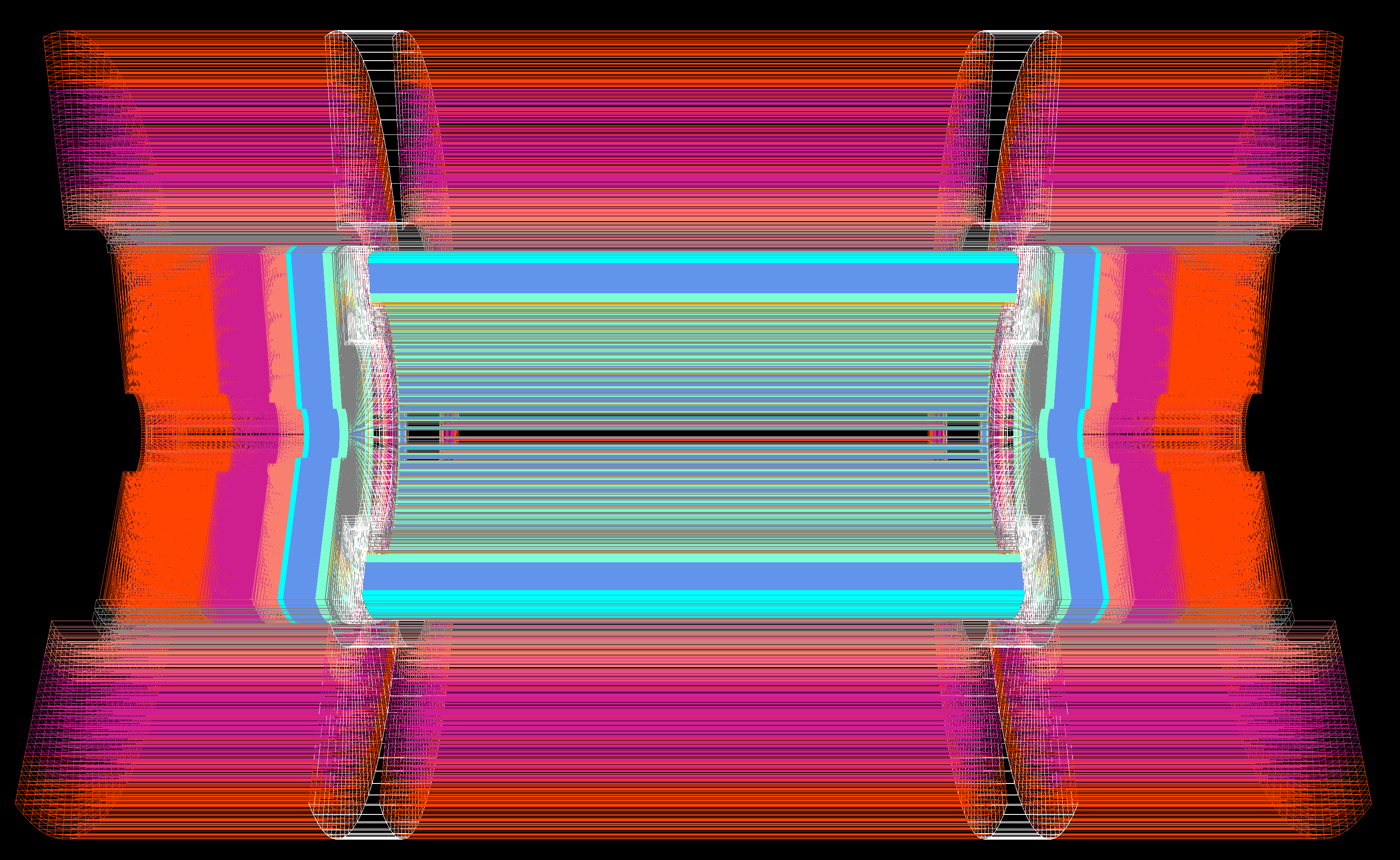
Figure 1: Lorenzetti Detector Geometry showing ECAL and HCAL layers (Simplified).
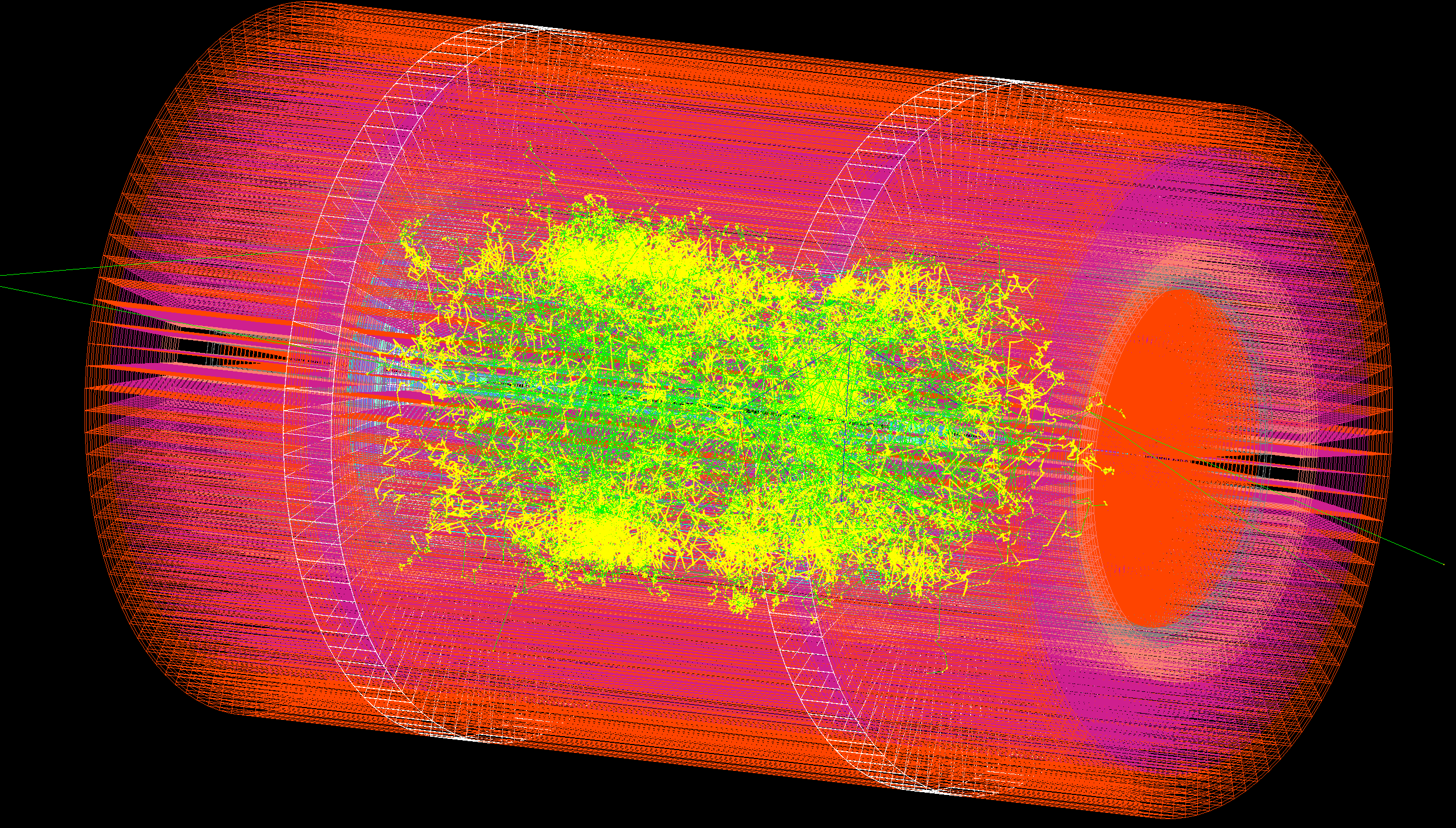
Front View |
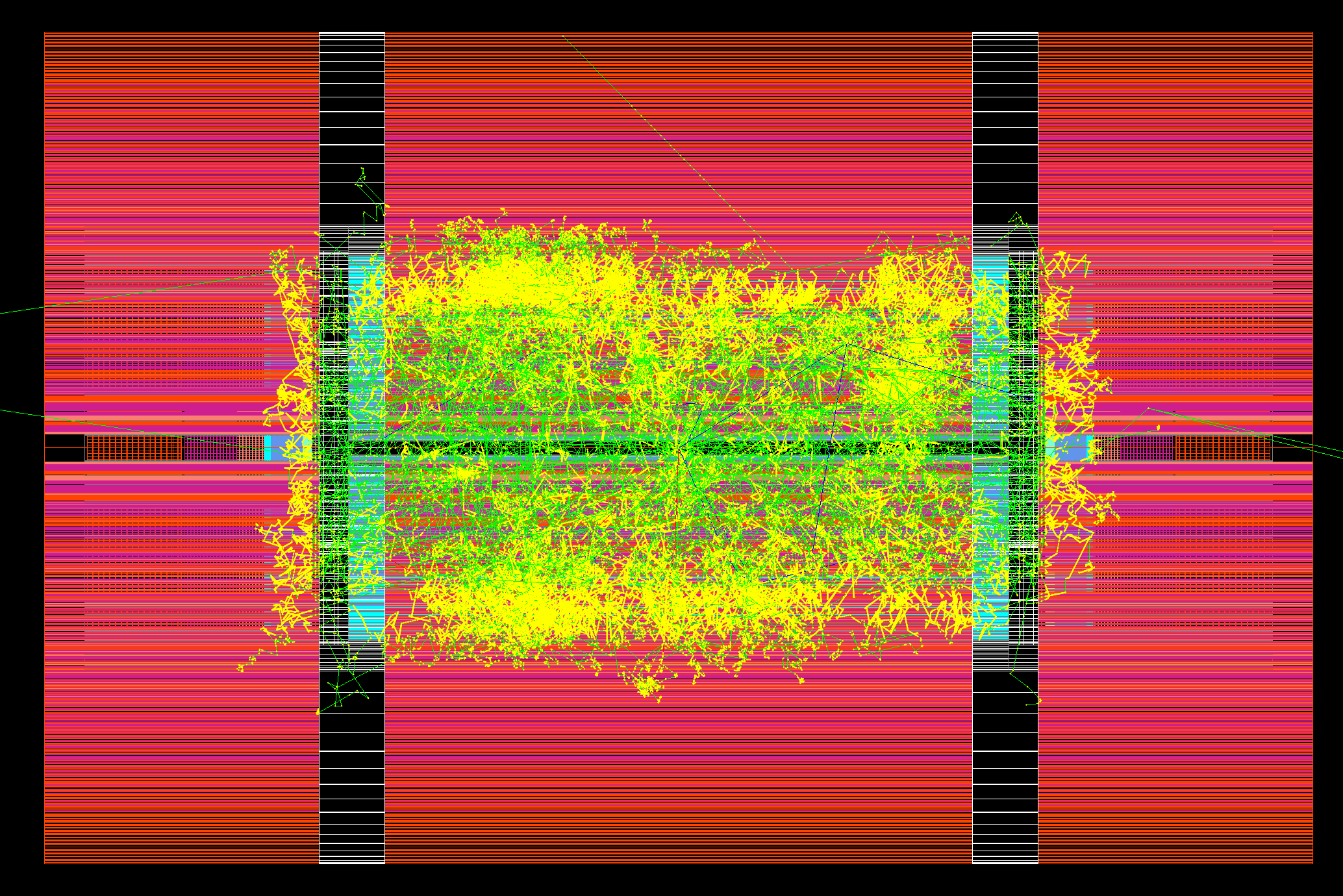
Lateral View |
Electromagnetic Calorimeter (ECAL)
A sampling calorimeter designed to measure electrons and photons with high precision.
Material: Lead (Pb) absorber plates interleaved with Liquid Argon (LAr) as the active medium.
Structure: * Pre-Sampler: A thin layer to correct for energy loss upstream. * Layer 1 (Strips): Finely segmented (Δη ≈ 0.003) for π⁰/γ separation. * Layer 2 (Middle): The thickest layer (55 radiation lengths) containing most of the shower energy. * Layer 3 (Back): Estimates energy leakage into the hadronic calorimeter.
Hadronic Calorimeter (HCAL)
Located outside the ECAL, this sampling calorimeter measures jets and missing energy.
Material: Iron (Fe) absorber plates with Plastic Scintillator tiles.
Structure: Divided into 3 longitudinal layers with coarser granularity (Δη × Δφ ≈ 0.1 × 0.1).
Detector Layers & Granularity
System |
Layer |
Name |
Material |
Granularity (Δη × Δφ) |
|---|---|---|---|---|
ECAL (Barrel) |
0 |
Pre-Sampler |
LAr / Pb |
0.025 × 0.1 |
1 |
Front (Strips) |
LAr / Pb |
0.003125 × 0.1 |
|
2 |
Middle |
LAr / Pb |
0.025 × 0.025 |
|
3 |
Back |
LAr / Pb |
0.050 × 0.025 |
|
TileCal (Barrel) |
1 |
Front |
Scint. / Fe |
0.1 × 0.1 |
2 |
Middle |
Scint. / Fe |
0.1 × 0.1 |
|
3 |
Back |
Scint. / Fe |
0.2 × 0.1 |
|
EMEC (EndCap) |
0 |
Pre-Sampler |
LAr / Pb |
0.025 × 0.1 |
1 |
Front |
LAr / Pb |
varies (0.003-0.006) × 0.1 |
|
2 |
Middle |
LAr / Pb |
0.025 × 0.025 / 0.1 × 0.1 |
|
3 |
Back |
LAr / Pb |
0.050 × 0.025 / 0.1 × 0.1 |
|
HEC (EndCap) |
1-3 |
All Layers |
LAr / Cu |
0.1 × 0.1 / 0.2 × 0.2 |
The geometry is highly customizable via Python scripts, allowing users to modify layer depths, material composition, and segmentation without recompiling the C++ core.
Contribution
We welcome everyone to contribute! 🌍 Whether it’s fixing bugs, adding new generators, or improving documentation.
Fork the repository.
Create your feature branch (
git checkout -b feature/AmazingFeature).Commit your changes.
Open a Pull Request.
Please ensure your code passes existing tests.
License
This project is licensed under the GNU General Public License v3.0 (GPLv3). See the LICENSE file for details.